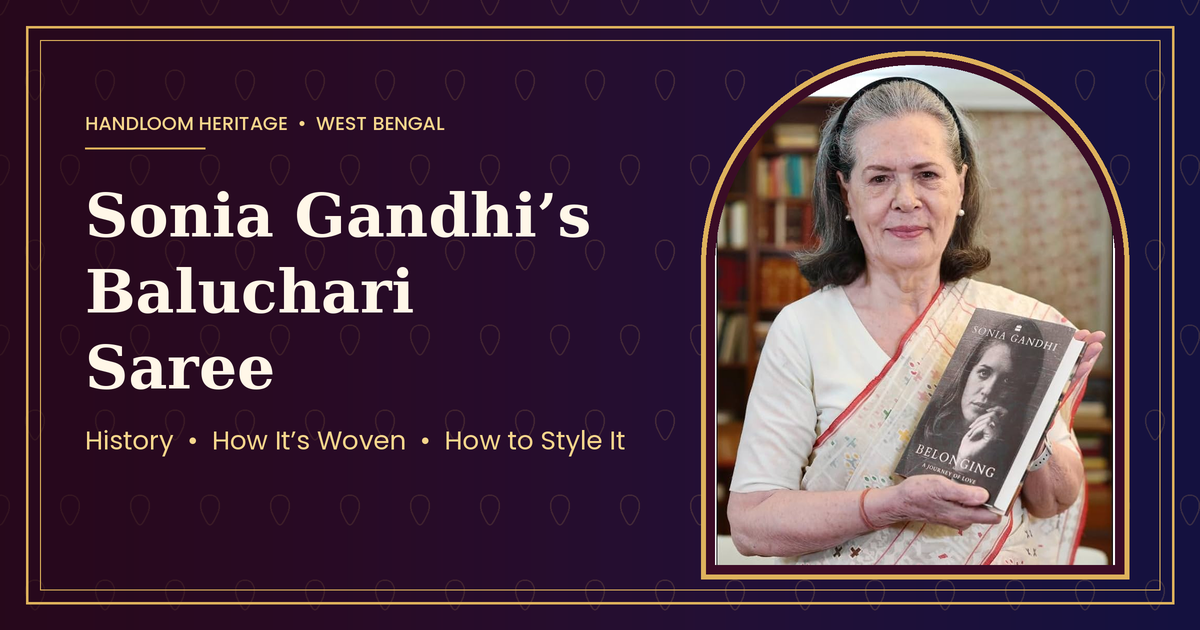
When Sonia Gandhi stepped out for the launch of her memoir, Belonging: A Journey of Love, in November 2026, the conversation was not only about the book. Many people were asking about the Baluchari saree she wore. What is it, why is it called a 300-year-old weave, and how is it made?
This guide answers all of that. You will learn the history of Baluchari silk, how the cloth is woven by hand in Bengal, how to tell a genuine piece from an imitation, and how to style a Baluchari saree for weddings, festivals and everyday occasions.
What was special about Sonia Gandhi’s Baluchari saree?
According to Asianet Newsable’s report on the launch look, the saree is a butedar (scattered-motif) piece in Malda silk, and the weavers used the Golani technique. The report links it to a Baluchari tradition with roughly 300 years of history. Media coverage described it as a vintage piece, though no source we found gives its exact age or maker, so treat the “300-year-old” label as a description of the weave’s heritage rather than a verified date for this one saree.
The choice also fits a pattern. Open magazine’s look at the Gandhi family wardrobe traces how her relationship with Indian clothing grew over the decades, and at a talk with fashion students she spoke in favour of restraint over heavy embellishment, as The Daily Star reported. A Baluchari, where the cloth itself is the decoration, is a natural fit for that taste. For a wider reflection on why the sari endures, read why the sari felt timeless to an outsider on Stylebistro.
If you want the background to the memoir itself, the Sonia Gandhi journey timeline lays out the key dates, and 10 life lessons from Sonia Gandhi’s life story covers the personal side of the book.
What is a Baluchari saree?
A Baluchari saree is a handwoven silk saree from West Bengal, famous for its pallu, which looks almost like a painting made of thread. The pallu often carries a narrative panel, with figures, scenes and a frame of smaller motifs around it. MENAFN’s explainer on the saree describes it as a handloom made from West Bengal mulberry silk with detailed brocade work on the pallu.
Common features include:
- Narrative pallu: scenes from the Ramayana and Mahabharata, temple stories or court life.
- Boxed border and buti motifs: small repeated motifs across the body, such as the kalka (paisley-like mango shape).
- Rich, deep colours: traditionally dark blues, purples, greens and maroons, plus modern pastels and neutrals.
- Soft, lustrous silk with a polished finish.
History of the Baluchari saree
Origins in Baluchar and Murshidabad
The weave is named after Baluchar, a village in Murshidabad. As the Asianet report notes, the story is tied to Murshid Quli Khan, the Nawab of Bengal from 1717 to 1727, who moved his capital from Dhaka to Murshidabad. Weavers moved with the court and settled in the Baluchar area, and the sarees they wove there became known as Baluchari. Early designs reflected the courtly world around them, including mango motifs and scenes of nobles and their pastimes.
Decline under colonial rule
As power in the region shifted after the Battle of Plassey in 1757, the patronage that supported fine silk weaving weakened. Accounts of the craft say it nearly died out during British rule for financial and political reasons, as Village Square’s report from Bishnupur puts it. The 1943 Bengal famine dealt another blow to weavers, according to Live History India.
The Bishnupur revival
Bishnupur, in the Bankura district, was once the capital of the Malla kings and already known for silk. In the first half of the 20th century, the artist Subho Thakur, then director of the Regional Design Centre in Calcutta, set out to revive the craft. He taught the jacquard method to a Bishnupur master weaver, Akshay Kumar Das, who carried it back and trained others, as described by The Statesman and the Craft Revival Trust. The two studied old Baluchari sarees that had been preserved in the Tagore family.
The Bishnupur versions often borrow from the terracotta temples of the town, so Hindu mythological scenes became a signature of the revived saree. Cooperative societies set up in the late 1970s and a GI tag in 2011 gave the craft further support, according to NewsClick and Village Square.
How a Baluchari saree is woven
The exact steps vary by workshop, but the process broadly runs like this.
- Sourcing and preparing the silk. The yarn is mulberry silk, and Village Square reports that it comes largely from Malda district. The thread is degummed and dyed, and the women of weaver households often handle thread preparation, according to NewsClick.
- Designing the pattern. An artist draws the border, buti and pallu designs on graph paper.
- Punching the cards. In the revival method, the design is translated into jacquard punch cards, which are stitched together in order and fixed on the loom. The Wikipedia entry on the Baluchari sari describes this step.
- Weaving. Two weavers usually work together on one loom, in shifts. Once the jacquard loom came into use, a typical saree takes around five to six days, though complex pieces take longer, per Deccan Herald.
- Finishing. The saree is polished after weaving so that it has its characteristic sheen.
The mirror technique and jala
Asianet’s report says Baluchari weavers work from the back of the cloth while watching the design in a mirror. This helps them check the pattern, which is formed on the reverse as they weave. Older and more flexible methods such as jala let weavers create pattern variations faster and more cheaply than the jacquard process, and today’s “Revival Baluchari” sarees are woven on both jala and jacquard looms, according to Deccan Herald’s feature on Bishnupur silks.
What is Golani weaving?
The launch coverage mentions the Golani technique, but it gives no technical detail. If you plan to write or speak about it, check with a Bishnupur weaving cooperative or a textile historian before explaining the method, rather than guessing.
Baluchari saree GI tag and how to spot a genuine one
Baluchari received a geographical indication (GI) tag in 2011. According to the Asianet report, only sarees made in West Bengal’s Bankura district count as original Baluchari for GI purposes. That makes the place of manufacture an important check.
Use this checklist before you buy:
- Ask for the weaver or cooperative name, and buy from state emporiums, cooperatives or reputable handloom sellers.
- Look for the GI tag or documentation and a Silk Mark label for pure silk.
- Turn the saree over. On handwoven pieces, the back shows float threads and is slightly less neat than the front.
- Check the pallu detail. Figures and scenes should be crisp, with clean outlines and no blurred areas.
- Be wary of very low prices. Machine-made copies and printed imitations often sell at a fraction of the cost.
Baluchari vs Banarasi: what is the difference?
The two are often confused, so here is a quick comparison.
| Baluchari | Banarasi | |
|---|---|---|
| Region | West Bengal (Bishnupur, Bankura) | Varanasi, Uttar Pradesh |
| Signature feature | Narrative panels in the pallu, in silk thread | Dense zari (metallic thread) brocade across the body |
| Typical motifs | Epics, temple and court scenes, mango shapes | Floral, paisley and jaal patterns |
| Overall look | Soft sheen, painterly pallu | Heavier, more glittering |
Coverage of the launch look described it as a Banarasi-style Baluchari, which shows how the two traditions are often discussed together. In practice, the narrative pallu is the easiest way to recognise a Baluchari.
How to style a Baluchari saree
Since the pallu is the star, styling is about letting it breathe. Britannica’s note on the sari points out that the garment is a single unstitched length of five to seven yards, and the same drape suits many occasions. Pick the drape and accessories to match the setting.
1. Choose a drape that shows the pallu
- Classic Nivi drape: pleat the front neatly and bring the pallu over the left shoulder. Pin it so the storytelling panel falls fully in view.
- Bengali atpoure drape: a wide, flowing pallu worn across the body suits a Baluchari and gives a traditional look.
- Open pallu: spread the pallu in a fan across the front for formal photos, and use a few pins to keep it tidy.
For a gentle start with drapes, the practice tips in Stylebistro’s essay on the sari are useful, including the advice to practise at home before an event.
2. Pair the blouse with the saree’s colours
- Contrast blouse: a plain silk or velvet blouse in a colour pulled from the border looks sharp.
- Matching blouse: a tonal blouse gives a seamless, regal effect.
- Keep the neckline simple. A boat neck, high neck or elbow-length sleeves work well and do not compete with the pallu.
3. Keep jewellery light
The weave is already detailed. A pair of jhumkas or a slim gold necklace is often enough, and you can add a single bangle or a pair of thin ones. Silver or oxidised pieces work well with deep indigo, green and maroon sarees. This echoes the restraint Sonia Gandhi has spoken about in Indian fashion, and ties in with the “let one element lead” idea in the Stylebistro essay.
4. Style it by occasion
- Weddings: choose a rich colour such as maroon or deep green, add temple jewellery and a bun with fresh flowers.
- Durga Puja and festive evenings: a red or white-and-red Baluchari with a gold border suits Bengali festivities. For other seasonal looks, see Navratri outfit ideas for women on Stylebistro.
- Office or day events: pick a lighter, buti-only Baluchari in a muted colour with minimal jewellery and flat sandals.
- Book launches and talks: a single statement saree with plain accessories, in the spirit of the launch look, keeps the focus on the cloth.
5. Hair, footwear and finishing touches
A low bun or a neat braid shows off the neckline and pallu. Closed-toe or embellished flats are easier than heels if you will be on your feet. Carry safety pins, since silk can slip, and add a fall to the hem if you want the saree to sit better.
How to care for a Baluchari saree
Handwoven silk needs gentle handling.
- Dry clean only, and ideally at a specialist who handles handloom silks.
- Store folded in a muslin or cotton cloth, not plastic, and refold along different lines every few months to prevent permanent creases.
- Keep it away from perfume and direct sunlight, since both can damage the silk and dyes.
- Air it out occasionally in a shaded, ventilated spot.
Baluchari saree price: what to expect
Prices vary widely with silk quality, design complexity and the time taken. A simpler piece costs far less than a heavily patterned one. Village Square, for example, met a Bishnupur weaver who was making a saree priced around Rs 1.5 lakh. Because quality varies so much, compare prices across a state emporium, a cooperative and a trusted handloom seller before you commit, and always ask for the weaving details in writing.
Frequently asked questions
Which saree did Sonia Gandhi wear at her book launch? She wore a Baluchari silk saree, described in media reports as a butedar in Malda silk with Golani weaving and a roughly 300-year heritage.
Where is the Baluchari saree from? It originated in Baluchar, in Murshidabad, and is now woven chiefly in Bishnupur, in West Bengal’s Bankura district.
Why is it called Baluchari? The name comes from the Baluchar region, where the weavers who followed the Nawab’s court first settled and wove the saree.
Who revived the Baluchari saree? The artist Subho Thakur and the Bishnupur master weaver Akshay Kumar Das are credited with reviving the craft in the first half of the 20th century.
How long does it take to weave a Baluchari saree? With a jacquard loom and two weavers, about five to six days for a typical piece, and longer for very intricate designs.
Does the Baluchari saree have a GI tag? Yes, it received a GI tag in 2011.
What are the main motifs on a Baluchari saree? Narrative pallu scenes from epics and temple art, court figures, and buti motifs such as the mango-shaped kalka.
Is Baluchari the same as Banarasi? No. Baluchari is from Bengal and is known for its storytelling pallu in silk thread, while Banarasi is from Varanasi and is known for zari brocade.
How do I style a Baluchari saree for a wedding? Choose a deep colour, a Nivi or atpoure drape that shows the pallu, a contrast silk blouse and temple jewellery.
Can I wear a Baluchari saree every day? It is best for occasions, since heavy silk needs careful care, but lighter buti-only pieces can work for formal daytime events.
Final thoughts
The Baluchari is a good example of a craft that nearly disappeared and was rebuilt by weavers, artists and cooperatives. Seeing it on a public stage has pushed many people to look up its story, and buying from the weavers of Bishnupur is the most direct way to support it. Whether you wear one to a wedding or a quiet event, let the pallu lead and keep the rest simple.
Resources and further reading
- Stylebistro: Why the sari felt timeless to an outsider
- Vofeg: Sonia Gandhi journey timeline
- Plusstories: 10 life lessons from Sonia Gandhi’s life story
- Asianet Newsable: Sonia Gandhi’s Baluchari saree and its history
- MENAFN: Why the Baluchari saree is making headlines
- Wikipedia: Baluchari sari
- Britannica: Sari
- Craft Revival Trust: Baluchari weaving of West Bengal
- Deccan Herald: Weaving timeless beauties
- Live History India: Baluchari, woven history
- Penguin Random House: Belonging by Sonia Gandhi